


What Is an Apostille and When Do South Africans Need One?
Correct as at 21 September 2026, verified against the Hague Conference status table and dirco.gov.za.
In short
- An apostille is a certificate attached to a public document confirming that the signature and seal on it are genuine, so a foreign authority will accept it
- It works only between members of the Hague Apostille Convention of 1961, which South Africa joined with effect from 30 April 1995
- If your destination is not a member, an apostille is worthless there and the document needs full legalisation through DIRCO and then that country’s embassy
- DIRCO will not accept a police clearance certificate older than six months, so the apostille must fit inside the window your destination is already measuring
- An apostille proves a document is genuine, it does not translate it and it does not vouch for what it says
Most South Africans meet the word apostille at the worst possible moment. The police clearance certificate finally arrives after months of waiting, and the receiving authority sends it straight back because it carries no apostille. The certificate was never the problem. The missing step was legalisation, and by then the six month clock on it is half spent. Our document attestation and apostille service covers the practical side.

What an apostille actually is
An apostille is a standardised certificate attached to a public document by an authority in the country that issued it. It confirms that the signature is genuine, that the person who signed held the office they claimed, and that the seal is authentic. That is the whole of it. It says nothing about whether the contents are true or your record clean. It authenticates the paper, not the substance.
It comes from the Convention of 5 October 1961 Abolishing the Requirement of Legalisation for Foreign Public Documents, usually shortened to the Hague Apostille Convention, which replaced a three step chain of certification, ministry authentication and embassy legalisation with one certificate. South Africa acceded on 3 August 1994 and it entered into force here on 30 April 1995, according to the status table kept by the Hague Conference on Private International Law. It is reciprocal, so it removes legalisation only between countries that are both parties to it.
The fork that costs people months
Every legalisation job starts with one question, and getting it wrong turns a three week task into a six month one.
If your destination is a Convention member, an apostille is the only formality required. DIRCO states that “if the convention applies, an apostille is the only formality that is required to authenticate the public document”. No embassy step, no second certificate.
If it is not a member, that route is closed. The document needs a certificate of authentication instead, and must then go to that country’s embassy or consulate in South Africa. Two authorities rather than one, with the embassy setting its own conditions and queues.
Membership has changed a great deal recently and much of the advice still online is stale. China is the common error. Guides written before 2023 list it as needing full embassy legalisation, which stopped being true on 7 November 2023, when the Convention entered into force for China following its accession on 8 March 2023. Saudi Arabia joined earlier, with effect from 7 December 2022. Others have not joined. When we checked the Hague Conference status table on 21 September 2026, the United Arab Emirates, Qatar, Kuwait and Egypt were not parties. Because the list moves, treat any version of it, this one included, as a prompt to check.
Which South African documents need one
The documents South Africans most often legalise fall into a few categories: SAPS police clearance certificates, unabridged birth, marriage and death certificates, letters of no impediment, educational qualifications, court orders, powers of attorney, and company documents.
Which route it takes depends on who signed it, not what it is about. Originals signed by a South African authority, such as Home Affairs certificates and SAPS police clearance certificates, go straight to DIRCO. Documents witnessed by a notary public or translated by a sworn translator take the High Court route.
Educational qualifications are the trap. DIRCO does not authenticate original degrees or diplomas at all. The qualification must first be verified by the relevant body: SAQA for tertiary qualifications, Umalusi for a matric certificate issued after November 2008, the Department of Basic Education for earlier ones, and QCTO for trades. It is the verification letter that gets the apostille, not your degree.
Who issues an apostille in South Africa
Two authorities issue them, and using the wrong one wastes a full cycle. The DIRCO Legalisation Section handles original public documents. It sits in the OR Tambo Building, 460 Soutpansberg Road, Rietondale, Pretoria, and issues either an apostille or a certificate of authentication depending on the destination, which is why the destination must be stated on submission.
The Registrar of the relevant High Court division handles documents that have gone through a notary public or sworn translator, who must be registered in the same jurisdiction. For Convention destinations the High Court apostilles them and they are then finished. DIRCO states plainly that “DIRCO will not apostille High Court Authentications and notarial certificates”. For non-Convention destinations the High Court authenticates and the document goes on to DIRCO.
DIRCO offers online bookings for individuals, daily except Wednesdays, plus courier submission and submission through registered service providers. If you are already overseas, a South African embassy, high commission or consulate can forward a document to the Legalisation Section by diplomatic bag, but only where it needs no prior verification step, and missions abroad cannot issue apostilles themselves, only certificates of authentication. A notice on its legalisation page states that from 1 September 2026 the walk-in service is discontinued and only clients with confirmed bookings will be assisted. That date has passed, but lower sections of the same page still describe a small walk-in allocation, and the page gives two different numbers of daily booking slots. Treat a confirmed booking as compulsory and check the page again before travelling.
The police clearance sequencing trap
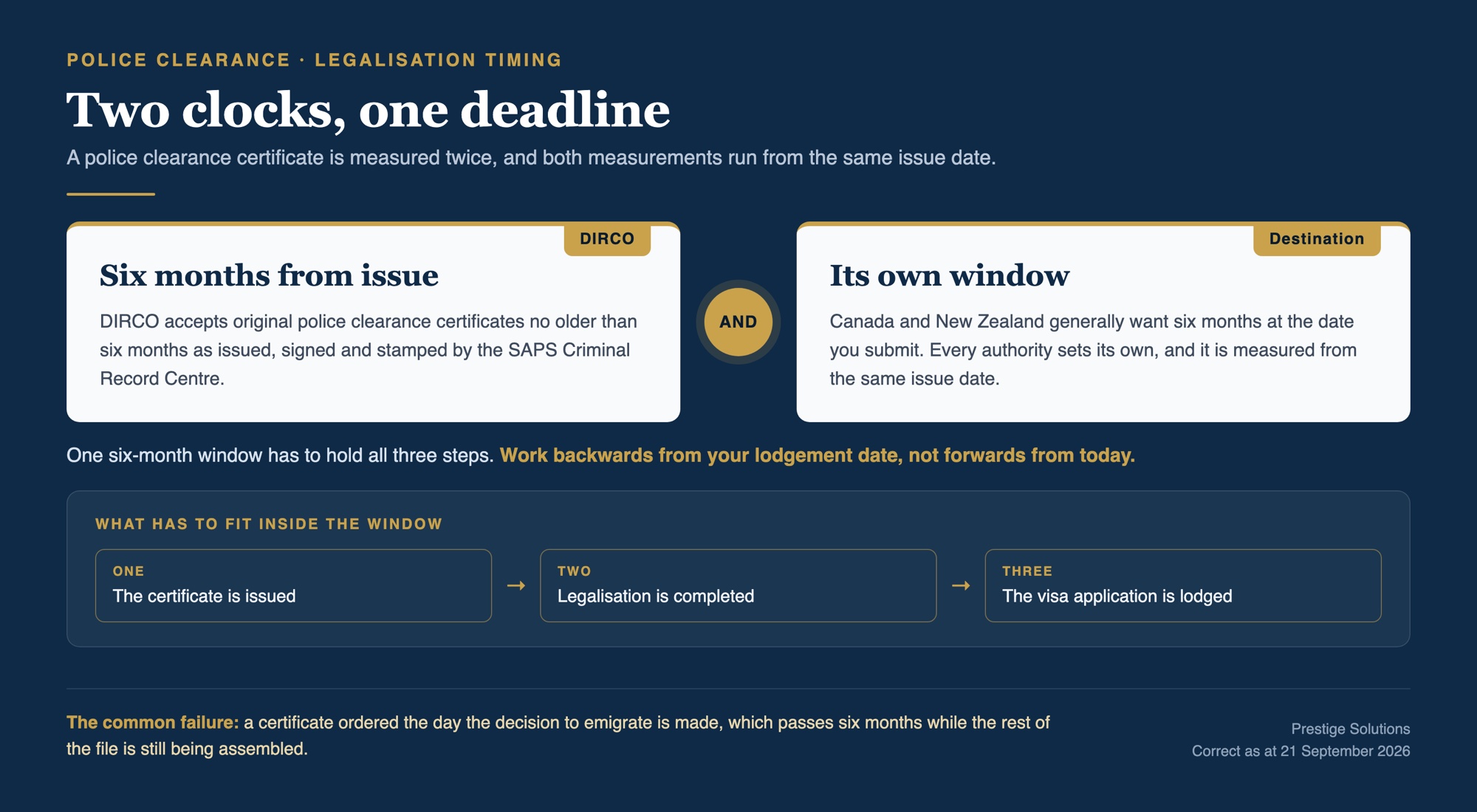
This is where most of the damage happens, and it is avoidable. An apostille can only be attached once a certificate exists, so nothing can be done in advance. Meanwhile DIRCO and your destination each apply a recency window to that certificate, and the two run on the same clock.
DIRCO accepts only original police clearance certificates “no older than six (6) months as issued, signed and stamped” by the SAPS Criminal Record Centre. Miss that and DIRCO will not touch it, whatever your visa timeline says.
Destinations apply their own version. For Express Entry, Canada requires the certificate for the country where you currently live to be “issued no more than 6 months before the date you submit your application”. Immigration New Zealand tells applicants to “make sure the police certificate is less than 6 months old when you submit your visa application”. Our article on police clearance for immigration sets out the windows destination by destination.
So one six month window must hold three things: the certificate being issued, the legalisation completed, and the visa lodged. Work backwards from a realistic lodgement date, not forwards from today. Do not apply for a police clearance certificate the moment you decide to emigrate. Apply once you can see that date, and build legalisation into the gap.
How long legalisation takes
Based on what our clients and enquirers report, completed certificates commonly take one to six months from fingerprints to delivery. That is a client-reported range, not an SAPS published figure. Our piece on how long a police clearance certificate takes unpacks the stages behind it.
DIRCO’s published processing times are shorter than most people expect. For booking clients it states that five documents or fewer are processed same-day, five to ten take one day and eleven or more take two working days, with exceptions where a signature is not already on DIRCO’s records. Courier submissions are given as three to four weeks, and registered service providers one to two.
Those figures cover the Legalisation Section only. They exclude the appointment, verification steps, notarial and High Court work, courier transit and the embassy stage. Plan on the chain, not the counter.
What goes wrong
Apostilling a copy instead of an original. DIRCO does not authenticate certified copies of civic certificates, police clearance certificates, identity documents or qualifications, and copies signed by a member of the SAPS are refused outright. Laminated documents too.
Apostilling a document the destination will not accept anyway, or sending an apostille to a non-member country. Either way it comes back and restarts.
Letting the underlying document expire mid-process, usually a police clearance certificate that passes six months in a courier queue.
Missing a translation requirement. If the receiving authority needs another language, that is a separate sworn translation with its own authentication chain through the High Court.
Assuming the apostille is that translation. It is not. It certifies the signature and seal, in whatever language the document was written.
How Prestige Solutions helps
We sequence and run the legalisation so the steps happen in the right order and inside the windows that matter. That means settling the Convention question first, routing each document correctly, and tracking its expiry against your lodgement date.
The boundaries are worth stating plainly. We do not control DIRCO turnaround, SAPS processing or embassy queues. We cannot make a non-Convention country accept an apostille, and we cannot legalise a document the issuing authority will not authenticate. What we remove is avoidable failure, which is where almost all lost time sits. Applying from abroad adds complications, covered in our guide to the police clearance certificate from abroad.
Frequently asked questions
Is an apostille the same as certification by a commissioner of oaths?
No. A commissioner of oaths certifies a copy or administers an oath, for use inside South Africa. An apostille is addressed to a foreign authority and certifies the official who issued the document.
Does my police clearance certificate need an apostille?
Often, but not always. Some authorities accept the SAPS certificate as issued, others require it apostilled or legalised. Confirm before it is issued, so legalisation fits inside the six month window.
How long is an apostille valid?
The apostille carries no expiry date. What expires is the document underneath it. DIRCO treats a police clearance certificate as valid for six months from issue, and destinations set their own windows. An apostille on a stale certificate rescues nothing.
What if my destination is not in the Convention?
It takes the full legalisation route. DIRCO authenticates it, or the High Court and then DIRCO where a notary is involved, and that country’s embassy or consulate here legalises it after that. Requirements differ by mission.
Can you apostille a document issued in another country?
No. DIRCO states that all foreign documentation must be legalised from the country of origin. A Zimbabwean birth certificate or a British degree must be legalised there, not here, even if you apply from South Africa.
Talk to us about your documents
If you are unsure whether your destination needs an apostille or full legalisation, answer that first, before any certificate is issued. Send us the document type and the destination and we will tell you which route applies and how to sequence it. Fees are confirmed on enquiry, and there is more on our document attestation and apostille service page.
WhatsApp +27 67 814 9534, call +27 11 568 0827 or email info@prestigesolutions.co.za. Monday to Friday, 08:00 to 17:00.
Sources
All sources accessed 21 September 2026.
- HCCH, Status table for the Convention of 5 October 1961 Abolishing the Requirement of Legalisation for Foreign Public Documents, hcch.net
- DIRCO, Legalisation Services, dirco.gov.za
- Government of Canada, Police certificates for Express Entry, canada.ca
- Immigration New Zealand, Police certificates, immigration.govt.nz